
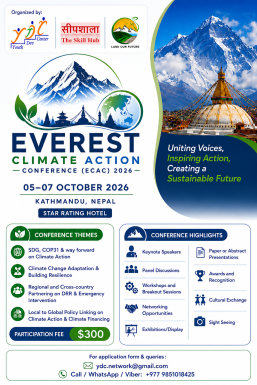
Date: 05- 07 October 2026
Venue: Kathmandu Nepal (Star Rating Hotel)
Co-Organizers: Youth Development Center (YDC), Sipshala– The Skill Hub, and Land Our Future (LoF).
Chairperson of Conference: Hon. Sunil Kumar Manandhar (Former Environment Minister)
Conference Themes
- SDG, COP31 & way forward on Climate Action
- Climate Change Adaptation & Building Resilience
- Regional and Cross-country Partnering on DRR & Emergency Intervention
- Local to Global Policy Linking on Climate Action & Climate Financing
Number of Delegates: 125 from south Asian countries & few observers are from rest of the world
Application Form: https://forms.gle/1GXZhjzjaVWkPK2C8
Conference Highlights
- Keynote Speakers
- Panel Discussions
- Workshops and Breakout Sessions
- Networking Opportunities
- Exhibitions / Display
- Paper or Abstract Presentations
- Awards and Recognition
- Cultural Exchange
- Sight Seeing
Participation Fee: $ 300- (residential) Conference fee covers 3 nights’ & 4 days food & accommodation, pick up/drop airport, kits (bag, t-shirt, stationery & souvenir), sight-seeing, certificate
Background
| From the Roof of the World, a Call to Act
“Uniting Voices, Inspiring Action, Creating a Sustainable Future.” |
Mount Everest has always symbolized what looks impossible until someone dares to attempt it. Today, the same peaks that have tested the limits of human endurance are sending an unmistakable warning: glaciers are retreating, monsoons are turning erratic, and the rivers that sustain nearly two billion lives downstream are changing course beneath our feet. The Himalaya is not a distant backdrop to the climate crisis — it is one of its clearest, most urgent front lines.
The Everest Climate Action Conference (ECAC) 2026 answers that warning with something the mountains have always inspired: resolve. Building on the momentum of the South Asian Climate Action Conference (SACAC) 2023 — which brought 125 delegates from across South Asia to Kathmandu for three days of dialogue on regional climate action — ECAC 2026 is the natural next chapter: a broader, bolder gathering that carries the network, partnerships, and commitments born in 2023 onto a global stage. From 05–07 October 2026, Kathmandu — gateway to the world’s highest peaks and a living museum of Himalayan culture — will once again host activists, researchers, policymakers, students, and civil-society leaders, this time drawing participants from around the world for three days of bold conversation, hard evidence, and shared commitment.
This is not a conference to simply talk about climate change — it is a summit to act on it. Delegates will move between keynote stages and hands-on workshops, between policy roundtables and cultural celebration, leaving not just with new ideas but with a global network of people equally determined to turn ambition into outcomes.
Why This Matters, Right Now
- Accelerating glacial melt across the Himalayas is increasing the risk of flooding and glacial lake outburst floods (GLOFs) for communities living downstream.
- Erratic monsoons and shifting seasons are straining agriculture and water security for the hundreds of millions of people across Asia who depend on these mountains and the rivers born from them.
- Communities across the region are already innovating — from renewable energy and climate-smart farming to community-led early-warning systems — but these solutions need a bigger stage, sharper policy links, and real financing to scale.
ECAC 2026 exists to close that gap: connecting the people closest to the problem with the platforms, partnerships, and funding that can turn local resilience into lasting, global impact.
Why Kathmandu, Why Now
Kathmandu sits in the shadow of the Himalaya and serves as the gateway to Everest and the broader mountain region — a fitting, symbolic home for a conference on mountain climate action. Early October arrives just after Nepal’s monsoon season, when the Kathmandu Valley is at its most beautiful: clear autumn skies, crisp mountain air, and views of the peaks that inspired this conference’s name. Delegates won’t just discuss the Himalaya from a conference hall — they’ll be standing in it.
From SACAC to ECAC: Building on a Regional Legacy
ECAC 2026 is the direct successor to the South Asian Climate Action Conference (SACAC) 2023, held in Kathmandu from 20–22 June 2023 under the same chairmanship of Hon. Sunil Kumar Manandhar and co-organized by the Youth Development Center (YDC) and Land Our Future (LOF). SACAC 2023 brought together 125 delegates from across Afghanistan, Bangladesh, Bhutan, India, the Maldives, Nepal, Pakistan, and Sri Lanka, and was inaugurated by the Vice President of Nepal, Hon. Ram Sahaya Yadav, with the participation of parliamentarians, senior bureaucrats, diplomats, and UN officials. Its thematic presentations, cross-cutting country sessions, and networking spaces produced a working network of youth climate leaders, researchers, and policymakers across the region, along with a shared set of recommendations on adaptation, disaster risk reduction, and climate financing.
ECAC 2026 carries that foundation forward and expands it. Joined by a new co-organizer, Sipshala – The Skill Hub, the conference retains SACAC’s core themes — updated to reflect COP31 and the current state of global climate negotiations — while widening its lens from a South Asia-only gathering to one that welcomes observers from beyond the region. The three-day format grows into a fuller summit, adding exhibitions, awards and recognition, and cultural exchange alongside the keynotes, panels, and workshops that defined SACAC. In effect, ECAC 2026 asks the network built in Kathmandu in 2023 to do more: to move from shared understanding toward shared, scalable action on the climate crisis unfolding across the Himalaya and beyond.
Continuity at a glance: same chairperson and lead organizers · same four core conference themes, updated for COP31 · same Kathmandu home base · an expanded, more global delegate base · a richer three-day program building directly on SACAC 2023’s foundation.
Objectives
The main objective of ECAC 2026 is to bring together delegates from around the world, including climate activists, researchers, scholars, government representatives, university students, and civil society pioneers in a single forum, to share their contributions, experiences, and knowledge on pertinent regional and global issues related to climate change and find practical solutions. The conference aims to facilitate knowledge sharing, promote collaboration and networking, and inspire young people to take action.
- To raise awareness: The conference aims to raise awareness about the impacts of climate change and the urgent need for action. It seeks to engage a broad range of stakeholders, including youth, civil society, researchers, and government officials, to build greater awareness of the challenges and opportunities associated with climate change.
- To share knowledge and experiences: The conference provides a platform for participants to share their knowledge and experiences of working on climate change issues, and seeks to facilitate dialogue between stakeholders and build a common understanding of the challenges and opportunities for climate action.
- To encourage collaboration: The conference seeks to encourage collaboration among stakeholders working on climate change issues worldwide, bringing together diverse perspectives and encouraging the development of partnerships that can help address complex, interconnected challenges.
- To develop innovative solutions: The conference aims to promote the development of innovative solutions to climate change challenges, encouraging participants to share ideas and explore new approaches and technologies that reduce emissions, build resilience, and promote sustainable development.
- To influence policy: The conference seeks to influence policy at the local, national, and international levels, providing an opportunity for stakeholders to engage with policymakers and share insights and recommendations for climate action.
Expected Outcomes
The Everest Climate Action Conference (ECAC) 2026 aims to achieve several expected outcomes:
- Building a network of young leaders: The conference aims to bring together young leaders from around the world who are passionate about tackling climate change, creating a strong global network that can work together to address climate issues.
- Sharing knowledge and experiences: The conference provides a platform for participants to share knowledge, experiences, and best practices related to climate action, leading to new and innovative ideas for tackling climate change.
- Developing regional and global partnerships: ECAC provides an opportunity for participants to develop partnerships with individuals and organizations worldwide, leading to more effective and coordinated efforts to address climate change.
- Identifying opportunities for collaboration: The conference aims to identify opportunities for collaboration between governments, non-governmental organizations, and the private sector, leading to more effective policies and actions to tackle climate issues.
- Raising awareness and advocacy: ECAC aims to raise awareness and advocacy on the importance of climate action. By bringing together young leaders and experts, the conference can generate media coverage and public attention on the issue.
- Promoting youth-led climate action: The conference aims to promote youth-led climate action and encourage young people to take a leadership role in addressing climate change, showcasing successful youth-led initiatives to inspire others.
Overall, the expected outcomes of ECAC 2026 are to build a strong global network of young leaders, share knowledge and experiences, develop partnerships, identify opportunities for collaboration, raise awareness and advocacy, and promote youth-led climate action.
Everest Climate Action Conference (ECAC) 2026
Secretariat: Youth Development Center (YDC)
ydc.network@gmail.com , www.ydc.org.np
+977 9851018425 (Call/WhatsApp/Viber)